




The mysterious dark matter | Science Pages
The observations of astronomers in the Universe have shown that we do not see matter in its entirety, only 5%. 68% is attributed to the dark energy due to the expansion of the Universe, while 27% is made up of dark matter, which does not interact with electromagnetic radiation. The astronomers came to this conclusion using supernova type 1a as the standard wax, the accelerating expansion of the Universe, but also the phenomenon of the gravitational lens, in order to calculate the mass of galactic clusters and found that there is much more matter directly in the Universe observable.
In addition, the fact that galaxies do not disintegrate, despite their rapid rotation, is due to the dark matter that surrounds them and which exerts gravitational pull. Relative measurements by astronomer Fritz Zwicky (1898-1974) in the galactic cluster of Virgo have shown that the mass of its galaxies is not enough to maintain its coherence, which suggests the existence of additional material (figure).
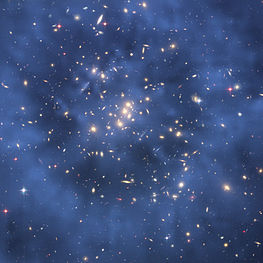
dark matter ring in galactic swarm CL 0024 + 17 as photographed by the Hubble Space Telescope
Source: hubblesite.org
Studies show that dark matter includes: 1) diffuse gas that does not emit light but can absorb light from a quasar. 2) very hot gases that do not emit in the visible electromagnetic spectrum, but X-rays. 3) very solid dark objects such as black holes and dead stars. It has even been suggested that much of the galaxy's mass consists of MACHO (Massive Astrophysical Compacte Halo Objects) objects, which do not emit light and are difficult to locate. Dark matter may also be composed of hypothetical exogenous particles (massive neutrinos, gravitons) called WIMPSs (Weakly Interacting Massive Particles).